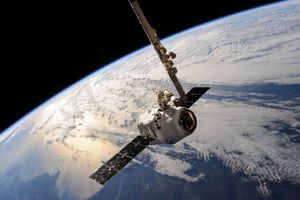
Washington, September 15, 2026 — The United States has publicly confirmed, for the first time, that it has operational weapons deployed in Earth orbit, marking a major development in the growing militarization of space.
U.S. Air Force Secretary Troy Meink made the disclosure on September 14 during the 2026 Air, Space and Cyber Conference in National Harbor, Maryland. He said the United States now has “on-orbit space control weapons” capable of defending the Joint Force against hostile adversary action.
The announcement represents the clearest public acknowledgment yet from Washington that American weapons are already operating in space. The U.S. military has previously discussed counter-space capabilities and the growing threat posed by rival nations, but officials had not publicly confirmed that weapons intended for space control were actually deployed in orbit.
What weapons are in orbit?
The Pentagon has not revealed what systems are involved.
Meink did not disclose the number of weapons, their orbital locations, when they were launched, or whether they are capable of physically destroying another spacecraft. U.S. officials have also declined to clarify whether the systems are kinetic weapons or non-kinetic capabilities such as electronic warfare or other methods of disrupting an adversary’s space assets.
The U.S. Space Force has described space control as encompassing both kinetic and non-kinetic methods intended to affect an adversary’s space capabilities, and said such capabilities can be used for both offensive and defensive purposes.
That leaves considerable uncertainty over the actual technology now deployed in orbit.
Experts have pointed to several possible categories of space-control weapons, including electronic jammers, directed-energy systems and kinetic weapons. However, there is currently no public evidence establishing which of these systems are represented by the newly acknowledged orbital capability.
A message to China and Russia
The disclosure comes as Washington, Beijing and Moscow increasingly treat space as a potential military domain.
U.S. officials have repeatedly warned that China and Russia are developing capabilities designed to disrupt, degrade or threaten American satellites. The U.S. Space Force identifies both countries as major sources of counter-space threats.
A U.S. Space Command official described Washington’s acknowledgment of the orbital weapons as a “landmark” moment and said the capability is intended in part to strengthen deterrence against hostile action.
Meink similarly indicated that the public disclosure was intended to contribute to deterrence, while avoiding the release of technical information that could compromise the systems.
China objects to the move
China responded strongly to the announcement on September 15.
Chinese Foreign Ministry spokesperson Guo Jiakun said Beijing opposes an arms race in outer space and warned against turning space into a battlefield. China urged Washington to stop expanding its military buildup in space and to take steps to preserve global strategic stability.
The reaction illustrates how the U.S. announcement could accelerate an already intense strategic competition in orbit.
Does international law ban weapons in space?
The announcement also raises questions about the legal status of weapons deployed in orbit.
The 1967 Outer Space Treaty prohibits placing nuclear weapons and other weapons of mass destruction in orbit around Earth. However, it does not impose a blanket prohibition on every type of conventional weapon in space. As a result, the deployment of certain conventional space-control systems occupies a complicated area of international space law.
This distinction is particularly important because not every space weapon necessarily involves physically destroying another satellite. Electronic interference, jamming and other non-kinetic capabilities can potentially disable or degrade an adversary’s systems without creating the large debris fields associated with destructive anti-satellite attacks.
Why the announcement matters
Modern militaries depend heavily on satellites for communications, navigation, intelligence, surveillance, missile warning and other functions. A conflict involving those systems could therefore have consequences far beyond orbit.
The United States, China and Russia have all developed or demonstrated counter-space capabilities, including systems capable of interfering with or attacking satellites. The latest U.S. disclosure takes the issue a step further by publicly confirming that American space-control weapons are already deployed in orbit.
For now, the most important unanswered question is what exactly those weapons are capable of doing.
Washington has confirmed their existence, but the Pentagon has kept their technical characteristics, numbers and orbital deployment locations classified.
The announcement therefore marks not the end of the secrecy surrounding U.S. space weapons, but a significant change in what Washington is willing to acknowledge publicly.